CHAVEZ RECEIVED NO INDIANS!
- Miraflores officials claimed that they had fulfilled the prerequisite of hearing request to the President, and also that prior commitments prevented him from their care.
- Instead of Chavez, the representative committee agreed to meet with Vice Admiral Torcatt Luis Alfredo Sanabria, head of the Office of the President and other officials of Miraflores.
- After the interview the representative of the march were satisfied with the outcome of the talks.

The stubborn march had been called under the sole criterion that "the only one who could decide to repeal the coal concessions in the Sierra de Perija, which is indigenous interests Chavez is with him that we want to talk. "
On the morning of March 31 Plaza Morelos Caracas overflowing enthusiasm. Early had begun to reach indigenous delegations, and in the street could be heard from the speakers to Aboriginal leaders who vigorously denounced the threats of coal mining in different languages, as dozens of video and photo cameras were besieging them, mostly from alternative media and activists. The general comment was that this would break up history into two periods, this new period could signal the emergence of indigenous movements in the Venezuelan revolution. Even, some wondered about his affinity with the Zapatista movement.
Homo et Natura AMNCLA, Collective Anpa, Americas Project, April 13 Movement, National Peasant Front Ezequiel Zamora, Aipo, Bolivarian Association of Lawyers of People's Power Promoters, Asocbariven, Cachirí Wayuu communities were the main organizations that convened the march. These organizations were noted in a statement whose headline that read: "THE REVOLUTION COME NO COAL and demands that the government modify its policy on coal."
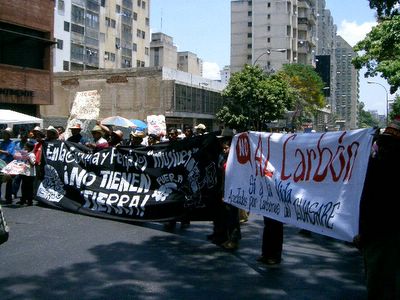
two banners with the slogans "No coal - SI A LA VIDA - AFFECTED BY THE CARBON OF Guasare" and "in La Guajira and Perija Musiú NOT HAVE THE LAND" led the march.
During the tour, shouted slogans in different indigenous languages, and of course, in Castilian. The Wayuu, Bari and the Yukpa, along with environmental groups Creoles clung to huge canvases painted with signs alluding to the fight against coal in the Sierra de Perija and demanded the repeal of the mining concessions, also appeared slogans against mining in the Sierra de Imataca. At the head of two large banners dominate the tip of the human stream passing of two thousand people, one said "in La Guajira and Perija Musiú NOT HAVE THE LAND" and the other "NO CARBON - SI A LA VIDA - Affected by Guasare coal. " Noted could surprise in the public passer, he wondered if perhaps it was not true that the Indians were satisfied with the awards made by the Bolivarian process. Leading the march was always Angela Gonzalez, leader of Cachirí Wuayuú, who encouraged aguerridamente mobilization at all times.

National Guard interrupted the indigenous demonstration and environmentalist
Carmelite Corner. From there
people veered Miraflores side access.
Then came the march to Miraflores, was tackled by a squad of National Guard at the height of the corner of the Carmelites. Hence the mass protesters went to a side entrance of the palace they call the "alcabala 5", where about 700 indigenous and environmentalists were posted with the intent to press for Chávez came out to greet them. The act culture that had been scheduled to be held very close to Miraflores, against Liceo Fermin Toro, was not carried out. Most of the protesters from Caracas and other parts of the country, excluding the zulia, only came to that part of Miraflores, and stayed there mostly indigenous protesters and activists from the Zulia.
slogans were shouted for several hours, demanding that Chavez attend all Indians, repeal the coal concessions CORPOZULIA delivered by the Sierra de Perija and out to meet with the Indians. In this there were some moments of concern and fear that arise a confrontation.
In the afternoon, when the march had been arrested by the military cordon, entered a commission to Miraflores, representatives of the Wayuu, Bari and Yukpa, and some non-indigenous leaders, including Lusbi Homo et Natura Portillo and Juan Carlos De la Rosa News Agencies of the People (NAFA), both wearing hats Wayuu. Along with them also participated Elpidio Gonzalez. Outside, the crowd stayed on condition that "if Chavez did not leave, there would wake." Long time after, he left the commission saying that he was told Vice Admiral Torcatt that "the interview was not with him, but Chavez himself ..." and left visibly determined not to accept anything.
Later, the commission re-entered. Finally, the same commission Torcatt accepted as a partner. The interview with the President, did not happen.
Leaving the meeting, Portillo Lusbi Homo et Natura, acted as spokesman for the natives and reported that "there was much sincerity in the meeting." He explained, inter alia, that the interview was videotaped and were promised that the tape was to be seen by Chavez. There was joy and tone Lusbi Portillo's speech was a victory achieved by the march. The President would meet the demands of indigenous peoples and environmentalists "deferred" ...
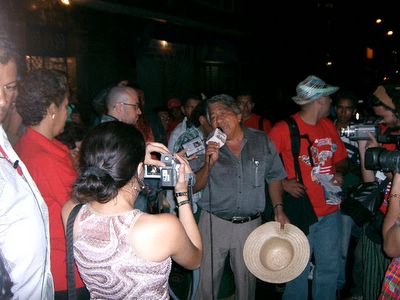
Leaving MIraflores, Lusbi
Portillo was the spokesman for the Indians
and explained the scope of the interview with Torcatt.
"There was a lot of sincerity in the meeting," he said.
Amncla later said that the meeting was agreed to open a dialogue between communities affected indigenous and Miraflores, based on the following agenda items:
- Cancellation of coal concessions in the Sierra de Perija (from Rio de Oro to Socuy).
- Hearing of the indigenous and social organizations with President Chávez .- Interview of indigenous representatives for not providing mediation .- demarcation of indigenous territories Perija and La Guajira.
- Letters indigenous agricultural farmers Mara.
- Compensation for workers and residents near the mines and the lives of patients with pneumoconiosis .- Review of the case of concessions granted to Socuy River Brazilians (the natives call for cancellation).
- immediate cessation of the exploration of transnational .- Send inspection committee of the Presidency of the Republic to the affected communities.
The delegation of the Bolivarian Front of People Affected by Coal Exploitation in
Guasare River basin successfully integrated the commission went to Miraflores, where the leader Wuayuú Alejandro Urdaneta, a former mine worker, seriously ill himself by unhealthy work of Guasare coal mining and peasant leader of the community most affected by mines in the Paso Diablo and Mina Norte, persuaded Juan Carlos De la Rosa was requires the participation of those affected by mining disaster Guasare area.
The letter that the Bolivarian Front of People Affected by Coal Exploitation delivered in Miraflores, letterhead and bears the following text:

Bolivarian Front of Affected by coal mining in Guasare River Basin.
Guasare River Basin, March 31, 2005 Citizen
Hugo Chavez Frias
President of the Bolivarian Republic of Venezuela Palacio de Miraflores
Caracas
Very Dear Compatriot:
Above all we wish to express our greetings Bolivariano reiterate the deep trust we placed in you
We are part of that eighty percent of Venezuelans living in extreme poverty hopeful revolutionary changes aimed at achieving social and participatory democracy, which seeks to, as you encourage us with their fair words, to "make it impossible to imperceptible violation of human rights violation that has been perpetrated by the richer to the detriment of poorer and poorer. The economic arrogance prevents them get justice, the common men and women who have been stripped of almost all the possibilities of personal initiative and responsibility and drag to live in conditions of life, work, unemployment and abysmal poverty, unworthy of the human person "(his letter to the Supreme Court in 1999).
Compatriot President, we want you to know our specific situation regarding with the consequences of coal mining in the mines of Guasare has brought to our Aboriginal communities from the moment they began to be exploited, until today, and reveal the true information of abandonment that we are undergoing in our current situation.
has officially said that farmers in this area have been incorporated into social programs and community care, and also maintaining a close cooperation with our neighborhood associations, with communities and people in general. It is also said to be carried out strict environmental control programs to prevent land and water pollution, and prevent impairment of health of our communities.
Serve this communication, appreciated President, to reveal that none of this applies to our case, that the rural communities of New Matera, El Paso, Manuelote, Cantalosgallos, Playa Bonita-The Mecocal, and The passion fruit, itself adjacent populations Guasare mines directly experience the effects of social exclusion and direct pollution caused by mining operations. During all these years until today, are part of a story of frustration and total neglect, characterized by dry rivers or intoxicated, unhealthy atmosphere, illness and death of miners, malnutrition, illiteracy, children without schools and without medical care, unemployment and destruction of our way of life, landless Indians, in short, social and environmental fraud expressed in The reduction of the quality of life and existence worthy of us, mostly indigenous in a very foreign to those specified in Article 299 of the Constitution of the Bolivarian Republic of Venezuela.
Compatriot President, none of it belongs to the Humanist Bolivarian Revolution built for the needs of human beings we dream together with you and where you are accompanying to the end. We want to reach the indigenous revolution Guasare. To achieve this goal we propose our control program to enforce our constitutional rights:
Wrestling Plan Bolivarian Front of People Affected by Coal Exploitation in Guasare River Basin
1) We demand an environmental study, sociocultural and epidemiological study to determine the real consequences of coal mining on our health, environment and lifestyle.
2) Creation of a Medical Clinic and Mission Barrio Adentro for communities affected by coal mining.
3) Development of a co-operative process, counseling, and provision of land and credit, respectful of our cultural traits Aborigines.
4) A Plan for Control of pollution caused by coal mining, which recognizes the social control and farmer participation in environmental protection work.
5) School of Bolivarian Schools Program.
6) popular Transportation Program.
7) Water Supply Program, drinking water and irrigation.
Finally, we wish to inform you that we are in solidarity with the struggle of indigenous brothers Bari, Yucpa and Wayuu, inhabitants of the Sierra de Perija those who refuse to suffer the same consequences of coal mining that we have suffered for 17 years continued in the area of \u200b\u200bthe Guasare coal.
are the signatures of the presidents of neighborhood associations in the communities adjacent to the mine Paso Diablo and Mina Norte.
Received and signed by the V / A Torcatt Luis Alfredo Sanabria at the Palace of Miraflores.


0 comments:
Post a Comment